Ewing Sarcoma in Children
Ewing sarcoma is a rare but aggressive cancer that most often affects children, adolescents, and young adults. Because symptoms may resemble common injuries or illnesses, diagnosis is sometimes delayed.
Treatment usually involves a combination of chemotherapy, surgery, and radiation therapy. While outcomes have improved over time, advanced and recurrent Ewing sarcoma remain difficult to treat, making continued research critical for improving survival and quality of life.
About Ewing Sarcoma
Ewing sarcoma is the second most common bone cancer in children. It most frequently develops in the long bones of the arms or legs, as well as the pelvis, chest wall, spine, and skull. In some cases, Ewing sarcoma begins in soft tissue rather than bone.
This cancer occurs most often in adolescents and young adults, with nearly half of cases diagnosed between the ages of 10 and 20. Ewing sarcoma is slightly more common in males than in females.
Ewing sarcoma is part of the Ewing sarcoma family of tumors, which includes Ewing sarcoma of bone, extraosseous (soft tissue) Ewing sarcoma, and peripheral primitive neuroectodermal tumors (PNET).
Most Ewing tumors are driven by a tumor-specific chromosomal translocation that creates a fusion gene. This change arises in the cancer cells and is not inherited. While the exact cause of Ewing sarcoma is unknown, the EWSR1-FLI1 fusion gene is believed to play a key role in how the cancer develops.
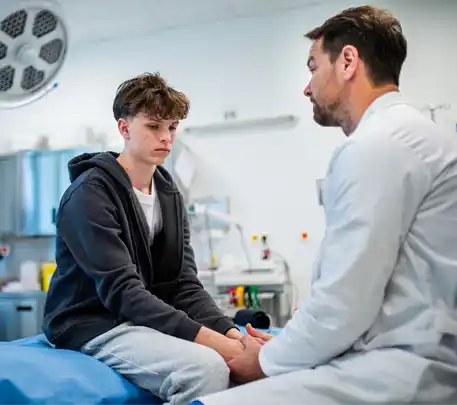
Symptoms of Ewing Sarcoma
Ewing sarcoma symptoms vary depending on where the tumor develops and whether the disease has spread, but they usually include:
Pain at the site of the mass, often with swelling.
Patients may have general symptoms such as loss of appetite, fever, malaise, fatigue, and weight loss.
Other symptoms are related to the specific location of the tumor. Classic symptoms include chest pain and shortness of breath in tumors that originate in the ribs, and back pain and "sciatic-like" symptoms in patients with tumors in the pelvis.
Because pain may initially resemble a sports injury or growing pains, symptoms are sometimes overlooked in early stages.
Prognosis and Factors Affecting Outcomes
A child’s prognosis depends on several factors, including tumor size, location, response to therapy, and whether the cancer has metastasized at diagnosis.
Children with localized Ewing sarcoma generally have better outcomes than those with metastatic or recurrent disease. Despite advances in treatment, survival rates for advanced Ewing sarcoma have remained relatively unchanged in recent decades, highlighting the urgent need for new therapies.
CureSearch-Funded Ewing Sarcoma Research
At CureSearch, we are accelerating research to improve outcomes for children with Ewing sarcoma, particularly those with advanced or hard-to-treat disease.
CureSearch has supported innovative projects such as research led by Dr. Lee focused on developing a new immunotherapy for treating children with advanced Ewing sarcoma, and a novel epigenetic therapy approach led by Dr. Beckerle that aims to target the underlying biology of Ewing sarcoma.
Families and survivors continue to inspire this work, including stories like this childhood Ewing sarcoma survivor on a mission to inspire others.
CureSearch Legacy Funds
Families facing Ewing sarcoma often ask how they can turn heartbreak into hope. Through a CureSearch Legacy Fund, you can honor your child while directly supporting the most promising Ewing sarcoma research without the burden of starting a private foundation. Join the dedicated families already advancing progress and create a lasting impact for children and families who need better treatments now.